Architecture
Sirchmunk’s architecture is organized into cleanly separated layers, following the principle of Separation of Concerns.
System Overview
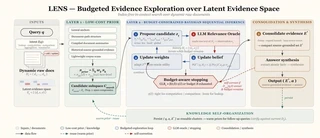
LENS Framework
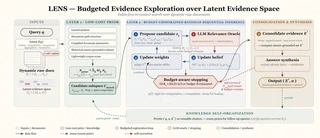
LENS (Latent Evidence Exploration and Search) is an index-free retrieval framework that formulates in-context search as Budgeted Evidence Localization over a latent evidence space induced by dynamic raw documents. Instead of pre-materializing evidence via embedding indexes or chunk stores, LENS maintains a query-conditioned belief over candidate evidence units and iteratively:
- Proposes candidates via complementary lexical, local, and exploratory proposal policies
- Updates the belief via an LLM relevance oracle
- Narrows toward high-posterior regions under a controllable token budget
This formulation makes the search process adaptive, budget-aware, and fully grounded in source documents — without any pre-built index infrastructure.
Paper: LENS: In-Context Search via Latent Evidence Exploration over Dynamic Raw Documents (arXiv 2026)
Knowledge Graph
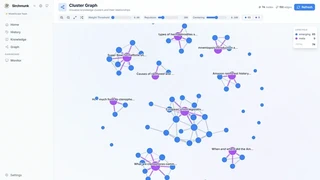
The Knowledge Graph provides an interactive visualization of self-evolving knowledge clusters built incrementally from search interactions. Powered by Cytoscape.js, it displays:
- Cluster relationships — semantic edges linking related knowledge units
- Lifecycle states — visual encoding of Emerging → Stable → Deprecated transitions
- Leiden meta-clustering — higher-level community structure discovered via the Leiden algorithm
Users can explore, filter, and drill into clusters directly from the Web UI.
See the Knowledge Evolution showcase for an animated demonstration of how clusters evolve over time.
Core Components
| Component | Description |
|---|---|
| AgenticSearch | Search orchestrator with FAST / DEEP / FILENAME_ONLY modes and budget-aware evidence localization |
| KnowledgeBase | Persists source-grounded evidence clusters as reusable warm priors for later queries |
| EvidenceProcessor | Consolidates candidate regions into compact, traceable evidence units |
| GrepRetriever | High-performance indexless file search with parallel processing |
| OpenAIChat | Unified LLM interface supporting streaming and usage tracking |
| KnowledgeCompiler | Offline document compilation into tree indices and knowledge clusters (Beta) |
| KnowledgeLint | Knowledge health checks and auto-repair |
| MonitorTracker | Real-time system and application metrics collection |
Multi-Phase Search Pipeline
At the heart of Sirchmunk is a multi-phase search pipeline designed around maximum parallelism within each phase and strict phase dependencies between them.
Phase 0 — Knowledge Cluster Reuse
Before any computation begins, the system checks whether a semantically similar query has been answered before. A lightweight embedding of the query is compared via cosine similarity against stored knowledge clusters. If a close match is found (above a configurable threshold), the cached cluster is returned immediately — providing sub-second response times for repeated or paraphrased queries.
This is not merely a cache — it is the beginning of knowledge compounding. Each reuse appends the new query to the cluster’s history, so the system remembers which questions led to which insights.
Phase 1 — Parallel Probing
Multiple independent probes launch concurrently to gather diverse signals:
- LLM Keyword Extraction — The LLM decomposes the query into multi-level keywords, from coarse (high recall) to fine (high precision), each annotated with an estimated rarity score.
- Directory Structure Scan — The file system is traversed to collect path metadata: file names, sizes, modification times, and content previews — the foundation for intelligent inference using structural cues.
- Knowledge Cache Lookup — Partial match search across existing clusters for potential reuse of previously acquired knowledge.
- Compile Artifact Load — Previously computed tree indices, topic maps, and summary indexes are loaded when available.
Phase 2 — Multi-Path DEEP Retrieval
In v0.2.0, DEEP mode runs 5 complementary retrieval paths in parallel:
| Path | Signal |
|---|---|
| Lexical | IDF-weighted keyword search through raw file contents |
| Entity | Exact-match entity lookup for named entities and identifiers |
| Directory | Structure-based ranking via LLM-guided metadata evaluation |
| Structural | Heuristic document tree navigation using compile artifacts |
| Topic-Graph | Cross-document topic-map traversal for multi-hop discovery |
Results from all paths are fused via confidence-weighted Reciprocal Rank Fusion (RRF). A soft route collapse mechanism dynamically disables low-yield paths — when a single path achieves high confidence with strong margin, the remaining paths are collapsed to cut latency and tokens while preserving answer quality.
Phase 3 — Evidence Localization & Cluster Construction
Results are merged, deduplicated, and processed through budgeted evidence localization. The LLM synthesizes evidence fragments into structured Knowledge Clusters.
Phase 4 — Summarization or ReAct Refinement
- Evidence found → LLM generates a structured briefing with source-linked evidence
- No evidence → ReAct agent activates for iterative exploration with hop-aware strategies
Phase 5 — Persist
Valuable clusters are saved with their embeddings for future reuse.
Key Algorithms
Budgeted Evidence Exploration
Traditional retrieval systems read entire documents or rely on fixed-size chunks, leading to either wasted tokens or lost context. LENS instead treats the relevant evidence as latent and query-conditioned: the system first forms a low-cost prior over likely evidence regions, then spends LLM calls only where observations are most useful.
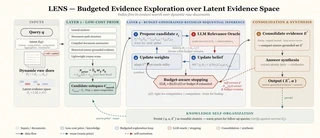
The workflow has three layers:
Low-cost prior: Lexical anchors, document-path structure, compiled summaries, historical source-grounded evidence, and lightweight corpus scans narrow the candidate subspace before expensive oracle calls.
Budget-constrained sequential inference: Candidate regions are proposed, observed by an LLM relevance oracle, and used to update the belief state until the budget-aware stopping rule says the evidence is sufficient.
Consolidation and synthesis: Selected regions are merged into a compact source-grounded evidence set, synthesized into an answer, and optionally persisted as reusable knowledge for follow-up queries.
Key properties:
- Index-free over raw documents: Search can run directly over dynamic files without pre-materializing a persistent embedding or chunk index.
- Source-grounded: The final answer is paired with traceable evidence regions instead of opaque vector hits.
- Budget-aware: LLM calls are spent adaptively on uncertain or high-value evidence regions, with explicit telemetry for cost and latency.
ReAct Agent
An autonomous Think → Act → Observe loop with:
- Prioritized tool strategy (keyword search → file read → knowledge query → directory scan)
- Dual-budget mechanism (token budget + loop count)
- Memory of previously explored avenues
Self-Evolving Knowledge Clusters
Sirchmunk does not discard search results after answering a query. Instead, every search produces a KnowledgeCluster — a structured, reusable knowledge unit that grows smarter over time. This is what makes the system self-evolving.
What is a KnowledgeCluster?
A KnowledgeCluster is a richly annotated object that captures the full cognitive output of a single search cycle:
| Field | Purpose |
|---|---|
| Evidences | Source-linked evidence regions localized by LENS, each with file path, summary, and raw text |
| Content | LLM-synthesized markdown with structured analysis and references |
| Patterns | 3–5 distilled design principles or mechanisms identified from the evidence |
| Confidence | A consensus score \[0, 1\] indicating the reliability of the cluster |
| Queries | Historical queries that contributed to or reused this cluster (FIFO, max 5) |
| Hotness | Activity score reflecting query frequency and recency |
| Embedding | 384-dim vector derived from accumulated queries, enabling semantic retrieval |
Lifecycle: From Creation to Evolution
 ┌─────── New Query ───────┐
 │                          ▼
 │     ┌──────────────────────────────┐
 │     │  Phase 0: Semantic Reuse     │──── Match found ──→ Return cached cluster
 │     │  (cosine similarity ≥ 0.85)  │                     + update hotness/queries/embedding
 │     └──────────┬───────────────────┘
 │           No match
 │                ▼
 │     ┌──────────────────────────────┐
 │     │  Phase 1–3: Full Search      │
 │     │  (keywords → retrieval →     │
 │     │   evidence localization →   │
 │     └──────────┬───────────────────┘
 │                ▼
 │     ┌──────────────────────────────┐
 │     │  Build New Cluster           │
 │     │  Deterministic ID: C{sha256} │
 │     └──────────┬───────────────────┘
 │                ▼
 │     ┌──────────────────────────────┐
 │     │  Phase 5: Persist            │
 │     │  Embed queries → DuckDB →    │
 │     │  Parquet (atomic sync)       │
 └─────└──────────────────────────────┘
Reuse Check (Phase 0): Before any retrieval, the query is embedded and compared against all stored clusters via cosine similarity. If a high-confidence match is found, the existing cluster is returned instantly — saving LLM tokens and search time entirely.
Creation (Phase 1–3): When no reuse match is found, the full pipeline runs: keyword extraction, file retrieval, budgeted evidence localization, and LLM synthesis produce a new
KnowledgeCluster.Persistence (Phase 5): The cluster is stored in an in-memory DuckDB table and periodically flushed to Parquet files. Atomic writes and mtime-based reload ensure multi-process safety.
Evolution on Reuse: Each time a cluster is reused, the system:
- Appends the new query to the cluster’s query history (FIFO, max 5)
- Increases hotness (
+0.1, capped at 1.0) - Recomputes the embedding from the updated query set — broadening the cluster’s semantic catchment area
- Updates version and timestamp
Key Properties
- Zero-cost acceleration: Repeated or semantically similar queries are answered from cached clusters without any LLM inference, making subsequent searches near-instantaneous.
- Query-driven embeddings: Cluster embeddings are derived from queries rather than content, ensuring that retrieval aligns with how users actually ask questions — not how documents are written.
- Semantic broadening: As diverse queries reuse the same cluster, its embedding drifts to cover a wider semantic neighborhood, naturally improving recall for related future queries.
- Lightweight persistence: DuckDB in-memory + Parquet on disk — no external database infrastructure required. Background daemon sync with configurable flush intervals keeps overhead minimal.
Knowledge Evolver
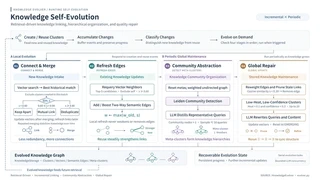
Beyond per-query cluster creation and reuse, the KnowledgeEvolver runs a four-phase background cycle that maintains the knowledge graph as a whole:
- Connect & Merge — Computes pairwise similarity among buffered clusters. Clusters with similarity ≥ 0.90 are merged; those with similarity ≥ 0.60 gain inter-cluster edges, consolidating fragmented knowledge from related queries.
- Refresh Edges — Re-evaluates existing edges, pruning stale connections and updating weights based on recent co-query patterns and semantic drift.
- Detect Meta Clusters — Leiden community detection (via igraph) discovers higher-order structure — groups of clusters that form coherent knowledge communities representing emergent domain expertise.
- Global Update — Synchronizes lifecycle states across the graph: consistently reinforced clusters graduate from Emerging to Stable; orphaned or contradicted clusters move toward Deprecated.
The entire cycle runs asynchronously, triggered by search activity (buffer counts and step intervals). Results persist to DuckDB + Parquet with an incremental manifest for crash recovery. The evolver never blocks the query hot path.
Data Storage
All persistent data is stored in the configured SIRCHMUNK_WORK_PATH (default: ~/.sirchmunk/):
{SIRCHMUNK_WORK_PATH}/
  ├── .cache/
    ├── history/              # Chat session history (DuckDB)
    │   └── chat_history.db
    ├── knowledge/            # Knowledge clusters (Parquet)
    │   └── knowledge_clusters.parquet
    ├── compile/              # Compile artifacts (Beta)
    │   ├── manifest.json     # File manifest with hashes
    │   ├── document_catalog.json
    │   ├── summary_index.json
    │   ├── trees/            # Hierarchical tree indices
    │   ├── table_digests/    # Table extraction digests
    │   └── xlsx_digests/     # Spreadsheet digests
    └── settings/             # User settings (DuckDB)
        └── settings.db
Design Principles
Sirchmunk adheres to SOLID principles:
- Single Responsibility — Each component has one clear purpose
- Open/Closed — Extended through abstractions, not modifications
- Liskov Substitution — All implementations honor abstract contracts
- Interface Segregation — Minimal, focused interfaces
- Dependency Inversion — High-level logic depends on abstractions
For a comprehensive technical analysis, read the Technical Deep Dive.
Paper: LENS: In-Context Search via Latent Evidence Exploration over Dynamic Raw Documents (arXiv 2026)