
Algorithm 进阶开发#
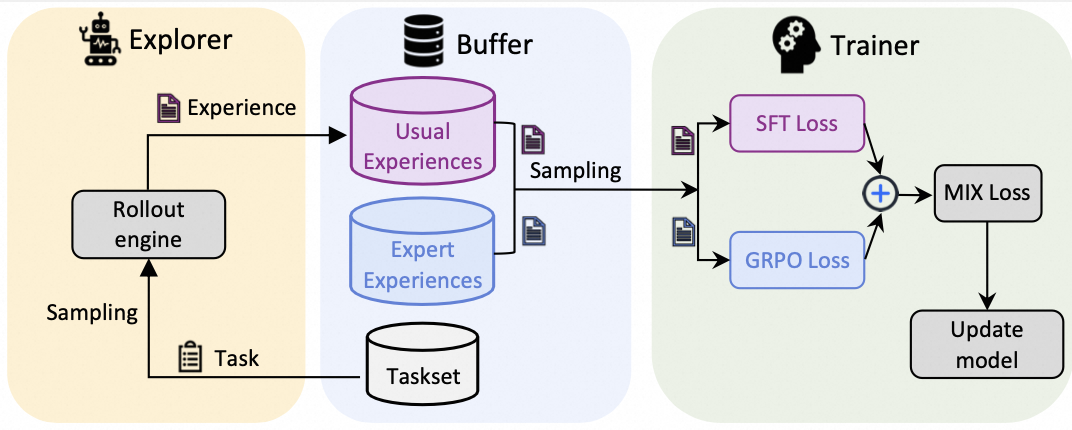
本指南将会介绍如何将相对复杂的 RL 算法集成到 Trinity-RFT 中。 作为示例,我们引入了由更高级别的 LLM 生成的一些“专家”数据,并提出了一种名为 MIX 的算法,该算法优化以下策略目标:
第一项对应标准的 GRPO 目标,旨在最大化期望奖励。最后一项是在专家数据上定义的辅助目标,鼓励策略模型(policy model)模仿专家行为。\(\mu\) 是一个权重因子,用于控制两项之间的相对重要性。
此流程的可视化如下所示:
步骤 0:准备专家数据#
我们提示一个强大的 LLM 对一些预定义问题使用 CoT(思维链)过程生成回答。收集到的数据被视为来自专家的一些 experience。我们将它们以 jsonl 格式存储在文件 expert_data.jsonl 中,格式如下:
{
    "messages": [
    { "role": "system", "content": "<system_prompt>" },
    { "role": "user", "content": "What is the sum of 4 and 12?" },
    { "role": "assistant", "content": "<think>thinking process...</think>\n<answer>16</answer>" } ]
},
...
专家数据的路径通过 buffer.trainer_input.auxiliary_buffers.sft_dataset 传入,供后续使用。
步骤 1:定义算法#
在 trinity/algorithm/algorithm.py 中,我们引入一个新的算法类型 MIX。
@ALGORITHM_TYPE.register_module("mix")
class MIXAlgorithm(AlgorithmType):
    """MIX algorithm."""

    use_critic: bool = False
    use_reference: bool = True
    compute_advantage_in_trainer: bool = False
    can_balance_batch: bool = True
    schema: str = "experience"

    @classmethod
    def default_config(cls) -> Dict:
        return {
            "repeat_times": 8,
            "advantage_fn": "grpo",
            "policy_loss_fn": "mix",
            "sample_strategy": "mix",
        }
步骤 2:定义采样策略#
我们需要在每一步读取两种类型的 experience 数据:普通 experience 和专家 experience。为此,我们定义了一个新的 experience 采样策略,名为 MixSampleStrategy。
class MixSampleStrategy(SampleStrategy):
    """The default sample strategy."""

    def __init__(self, buffer_config: BufferConfig, **kwargs):
        super().__init__(buffer_config)
        self.expert_data_ratio = kwargs.get("expert_data_ratio", 0.5)
        self.sft_dataset_name = kwargs.get("sft_dataset_name", "sft_dataset")
        tot_batch_size = buffer_config.train_batch_size
        expert_batch_size = ceil(self.expert_data_ratio * tot_batch_size)

        # experience buffer
        usual_buffer_config = copy.deepcopy(buffer_config.trainer_input.experience_buffer)
        usual_buffer_config.batch_size = tot_batch_size - expert_batch_size
        self.usual_exp_buffer = get_buffer_reader(usual_buffer_config)

        if buffer_config.trainer_input.auxiliary_buffers is None:
            raise ValueError(
                "`buffer_config.trainer_input.auxiliary_buffers` is required in MIX algorithm"
            )

        # expert experience buffer
        expert_buffer_config = copy.deepcopy(
            buffer_config.trainer_input.auxiliary_buffers[self.sft_dataset_name]
        )
        expert_buffer_config.batch_size = expert_batch_size
        self.expert_exp_buffer = get_buffer_reader(
            expert_buffer_config,
        )

    async def sample(self, step: int) -> Tuple[Experiences, Dict, List]:
        metrics = {}
        with Timer(metrics, "time/read_experience"):
            usual_exp_list = await self.usual_exp_buffer.read_async()
            for exp in usual_exp_list:
                if exp.info is None:
                    exp.info = {}
                exp.info["is_expert"] = False
                exp.info["step"] = step

            expert_exp_list = await self.expert_exp_buffer.read_async()
            for exp in expert_exp_list:
                # 设置一些 fake rewards and logprobs 以便兼容格式
                exp.reward = 0.0
                exp.logprobs = torch.zeros_like(
                    exp.tokens[exp.prompt_length :], dtype=torch.float32
                )
                exp.advantages = torch.zeros_like(
                    exp.tokens[exp.prompt_length :], dtype=torch.float32
                )
                if exp.info is None:
                    exp.info = {}
                exp.info["is_expert"] = True
                exp.info["step"] = step

            exp_list = usual_exp_list + expert_exp_list
            repr_samples = representative_sample(exp_list)

        with Timer(metrics, "time/gather_experience"):
            exps = Experiences.gather_experiences(
                experiences=exp_list,
                pad_token_id=self.pad_token_id,  # type: ignore [arg-type]
                custom_fields=[
                    CustomField(
                        source_field="is_expert",
                        destination_field="expert_mask",
                        data_type=torch.bool,
                    ),
                    CustomField(
                        source_field="step",
                        destination_field="step",
                        data_type=torch.int32,
                    ),
                ],
            )
        return exps, metrics, repr_samples
这里我们使用 Experiences.gather_experiences 的 custom_fields 参数来添加一个新字段 expert_mask,用以标识该 experience 是否来自专家。这个字段将在策略损失函数中被用来区分普通 experience 和专家 experience。
步骤 3:定义策略损失函数#
我们在 trinity/algorithm/policy_loss_fn/mix_policy_loss.py 中定义一个 MixPolicyLoss 类,它分别计算关于普通 experience 和专家 experience 的两个 losses 之和。
@POLICY_LOSS_FN.register_module("mix")
class MIXPolicyLossFn(PolicyLossFn):
    def __init__(
        self,
        backend: str = "verl",
        mu: float = 0.1,
        clip_range: Optional[float] = None,
        clip_range_low: Optional[float] = None,
        clip_range_high: Optional[float] = None,
        use_dynamic_bsz: Optional[bool] = None,
        ppo_mini_batch_size: int = 1,
        ppo_micro_batch_size_per_gpu: int = 1,
        ngpus_trainer: int = 1,
        train_batch_size_usual: int = 1,
        train_batch_size_expert: int = 1,
        sft_loss_agg_mode: str = "token-mean",
        grpo_loss_agg_mode: str = "token-mean",
    ) -> None:
        super().__init__(backend=backend)
        self.mu = mu
        self.use_dynamic_bsz = use_dynamic_bsz
        self.experience_per_gpu = ppo_mini_batch_size // ngpus_trainer
        self.gradient_accumulation = ppo_mini_batch_size // ppo_micro_batch_size_per_gpu
        self.train_batch_size_usual = train_batch_size_usual // ngpus_trainer
        self.train_batch_size_expert = train_batch_size_expert // ngpus_trainer
        self.grpo_loss_fn = PPOPolicyLossFn(
            clip_range=clip_range,
            clip_range_low=clip_range_low,
            clip_range_high=clip_range_high,
            loss_agg_mode=grpo_loss_agg_mode,
        )
        self.sft_loss_fn = SFTLossFn(loss_agg_mode=sft_loss_agg_mode)

    def __call__(  # type: ignore
        self,
        logprob: torch.Tensor,
        old_logprob: torch.Tensor,
        action_mask: torch.Tensor,
        advantages: torch.Tensor,
        expert_mask: torch.Tensor,
        **kwargs,
    ) -> Tuple[torch.Tensor, Dict]:
        assert (
            len(expert_mask) == logprob.shape[0]
        ), f"Error: {len(expert_mask)=} != {logprob.shape[0]=}"

        n_usual_exp = torch.sum(~expert_mask).item()
        n_expert_exp = torch.sum(expert_mask).item()

        if self.use_dynamic_bsz:
            per_micro_batch_weight_usual = self.experience_per_gpu / (
                logprob.shape[0] * self.train_batch_size_usual
            )
            per_micro_batch_weight_expert = self.experience_per_gpu / (
                logprob.shape[0] * self.train_batch_size_expert
            )
        else:
            per_micro_batch_weight_usual = self.gradient_accumulation / self.train_batch_size_usual  # type: ignore
            per_micro_batch_weight_expert = self.gradient_accumulation / self.train_batch_size_expert  # type: ignore

        if n_usual_exp > 0:
            grpo_loss, grpo_metrics = self.grpo_loss_fn(
                logprob[~expert_mask],
                old_logprob[~expert_mask],
                action_mask[~expert_mask],
                advantages[~expert_mask],
                **kwargs,
            )
            grpo_loss = grpo_loss * n_usual_exp * per_micro_batch_weight_usual
            grpo_metrics = {
                k: v * n_usual_exp * per_micro_batch_weight_usual for k, v in grpo_metrics.items()
            }
        else:
            grpo_loss = torch.tensor(0.0, device=logprob.device)
            grpo_metrics = {}

        # SFT Loss (expert)
        if n_expert_exp > 0:
            sft_loss, sft_metrics = self.sft_loss_fn(
                logprob[expert_mask],
                action_mask[expert_mask],
            )
            sft_loss = sft_loss * n_expert_exp * per_micro_batch_weight_expert
            sft_metrics = {
                k: v * n_expert_exp * per_micro_batch_weight_expert for k, v in sft_metrics.items()
            }
        else:
            sft_loss = torch.tensor(0.0, device=logprob.device)
            sft_metrics = {}

        loss = (1 - self.mu) * grpo_loss + self.mu * sft_loss

        metrics = {f"usual/{k}": v for k, v in grpo_metrics.items()}
        metrics.update({f"expert/{k}": v for k, v in sft_metrics.items()})
        metrics["loss"] = loss.item()

        return loss, metrics

    @classmethod
    def default_args(cls) -> Dict:
        return {
            "mu": 0.1,
            "clip_range": 0.2,
        }
步骤 4:运行实验#
通过上述新定义的类和函数,我们可以无需修改其他流程即可运行实验。
下面展示了一个包含关键配置的示例,包括权重因子 \(\mu\)(即 algorithm.policy_loss_fn_args['mu'])以及专家 experience 的批次大小 \(B'\),其值等于 buffer.batch_size、algorithm.sample_strategy_args['expert_data_ratio'] 和 algorithm.repeat_times 的乘积。完整配置请参考 mix_math.yaml。
algorithm:
  algorithm_type: mix
  repeat_times: 8
  sample_strategy_args:
    expert_data_ratio: 0.25
  policy_loss_fn_args:
    mu: 0.1
    clip_range: 0.2
    sft_loss_agg_mode: "token-mean"
    use_dynamic_bsz: True
    repeat_times: 8
    ppo_mini_batch_size: 256
    ppo_micro_batch_size_per_gpu: 4
    ngpus_trainer: 4
    train_batch_size_expert: 64
    train_batch_size_usual: 192
完成以上配置后,可通过以下命令运行实验:
trinity run --config examples/mix_math/mix_math.yaml